


Trends in incidence
From 1990 to 2021, the raw number of incident cases rose from 9,322,555 (9,226,040–9,419,071) to 21,460,265 (21,240,265–21,680,265) for males, showing an increase of 130.2% as shown in Supplement Table 2. The raw incidence rate for females increased from 10,419,425 (10,316,042–10,522,809) to 23,909,617 (23,680,512–24,138,722), showing a 129.5% rise. In addition, the ASIR per 100,000 individuals showed an increase by 23.5%, from 4,928.6 (4,846.63–5,013.26) to 6,088.22 (5,915.55–6,276.92) for males, and females increased by 26.1%, from 5,707.43 (5,610.00–5,807.43) to 7,195.58 (6,987.60–7,421.87) as shown in Fig. 1A.

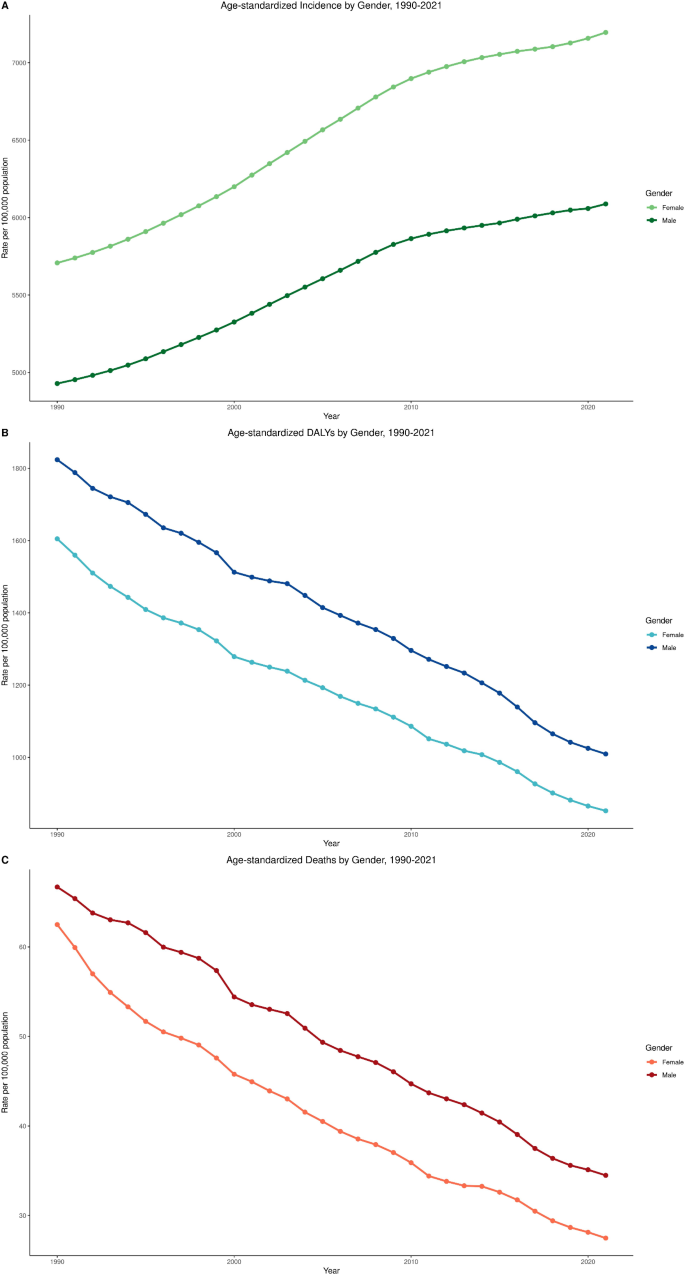
Trends in age-standardized rates by gender, 1990–2021
For cirrhosis and other chronic liver diseases, the ASIR per 100,000 individuals increased by 18.5% for males and by 23.3% for females. Upper digestive system diseases showed a significant increase in raw incidence cases, more than doubling for both genders. The ASIR had a slight increase of 0.2% for males, and of 0.9% for females. Gallbladder and biliary diseases’ ASIR decreased by 4.8% for males and 4.0% for females. For pancreatitis, ASIR decreased by 2.9% for males and 2.9% for females. For hernias, the ASIR decreased by 16.1% for males and 7.8% for females.
The incidence rate per 100,000 of specific diseases varied by age group as shown in Fig. 2. The peak incidence rate of cirrhosis and other chronic liver diseases was highest among individuals aged 20–24 years for both males and females. Gastroesophageal reflux disease also peaked in the 70–74 years age group, while inflammatory bowel disease showed its highest incidence in the 55–59 years age group in males and in the 45–49 years age group for females.

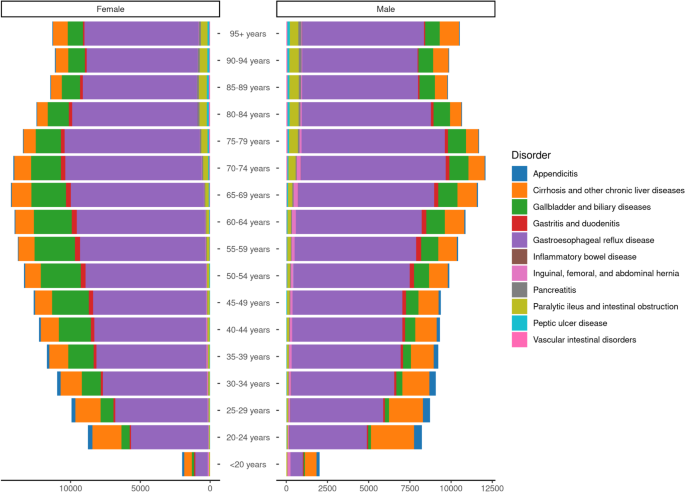
Incidence rates in 2021 attributable to risk factors across different age groups, males vs. females
Kuwait reported the highest ASIR in 2021 at 8,028.26 (7,147.84–9,160.50) and Afghanistan exhibited the lowest ASIR, with 4,949.94 (3,818.46–7,072.40) per 100,000 individuals. The overall ASIR EAPC for the region stands at 0.79, (CI: 0.74 to 0.84). Among the countries, Iran exhibits the highest increase, with an EAPC of 1.46 (CI: 1.31–1.61) as shown in Fig. 3A. The smallest increase is observed in Sudan with an EAPC of 0.28 (CI: 0.23–0.33). In contrast, Afghanistan shows a slight decrease in incidence rates, with an EAPC of -0.12 (CI: -0.25 to 0.01). The correlation between ASIR, DALYs, deaths with each of the indices (SDI, HDI and GII) in 2021 was examined in Fig. 4. ASIR and SDI had a strong positive correlation with a Pearson’s r of 0.90 (p-value < 0.001) (Fig. 4A). ASIR and HDI also demonstrated a strong positive correlation with Pearson’s r of 0.86 (p-value < 0.001) (Fig. 4B). Additionally, ASIR and GII showed a strong negative correlation with Pearson’s r of -0.86 (p-value < 0.001) (Fig. 4C). Further details on the distribution of digestive diseases by country can be found in Supplementary Fig. 1.

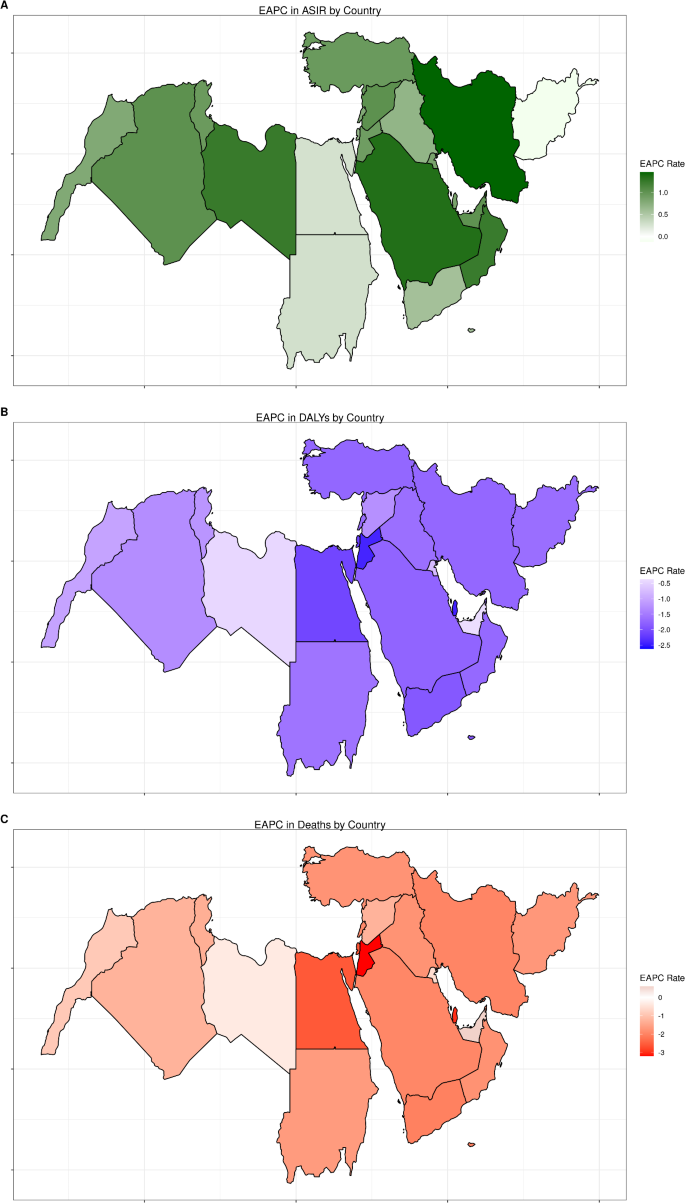
Estimated annual percentage change in age-standardized incidence, DALY, and death rates by country in the mena region

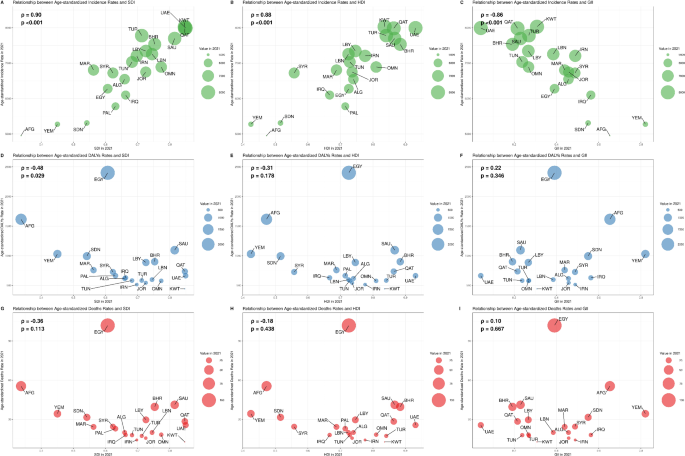
Relationships between age-standardized incidence, DALY, and death rates with socioeconomic indicators in 2021
Trends in DALYs
From 1990 to 2021, the total number of DALYs for all digestive diseases increased significantly from 3,641,292 (3,215,442–4,054,462) in 1990 to 4,764,470 (4,113,388–5,568,946) in 2021, showing a 30.8% increase as shown in Supplement Table 3. Despite these increases in raw DALY count, the age-standardized DALY rate per 100,000 individuals for these diseases decreased by 45.7%, from 1,719.63 (1,523.66–1,934.52) to 932.98 (813.63–1,078.52) per 100,000 individuals for both genders as shown in Fig. 1B.
For Cirrhosis and other chronic liver diseases, the age-standardized DALY rate showed a decline for males of 44.7%, and of 46.9% for females. Upper digestive system diseases showed a significant reduction in age-standardized DALY rates; for males, the rate decreased by 47.6%, while for females, the rate dropped by 17.3% decrease. Gallbladder and biliary diseases age-standardized DALYs rate in males decreased by 18.5%, and in females by 15.0%. Pancreatitis also experienced a decrease in males by 8.3%, and in females by 15.0%. Lastly, hernias decreased by 32.7% in males and by 32.9% in females.
In 2021, Egypt reported the highest age-standardized DALY rate in 2021 at 2,400.44 (1,993.79 to 2,857.72). In contrast, Kuwait exhibited the lowest rate, with 441.91 (365.32 to 543.50) per 100,000 individuals. The EAPC in DALY across MENA region reveals a consistent decline across all countries as shown in Fig. 3B. The overall EAPC for the MENA region was − 1.88 (CI: -1.93 to -1.82). Among the countries, Bahrain exhibits the most substantial decrease in DALYs, with an EAPC of -2.62 (CI: -2.90 to -2.34). The smallest decrease is observed in United Arab Emirates with an EAPC of -0.37 (CI: -0.74 to -0.01). Age-standardized DALY revealed a negative correlation with SDI in 2021 with Pearson’s r of -0.48 (p-value 0.029) (Fig. 4D). In contrast, age-standardized DALYs and both HDI and GII had no significant association with a p-value of 0.178, and 0.346, respectively as shown in Fig. 4E and F. Further details on the distribution of digestive diseases by country can be found in Supplementary Fig. 2.
Trends in deaths
As shown in in Supplement Table 4, the total number of deaths attributed to all digestive diseases from 1990 to 2021 rose significantly for both genders from 99,738 (88,407 − 113,320) in 1990 to 129,006 (113,108–148,493) in 2021, a 29.3% increase. However, the age-standardized death rate per 100,000 individuals decreased by 52.1%, from 64.84 (56.72–75.51) in 1990 to 31.07 (27.38–35.44) in 2021 as shown in Fig. 1C.
For cirrhosis and other chronic liver diseases, the age-standardized death rate declined for both genders. For males, the rate decreased by 48.1%, while females witness a 60.6% decrease. Upper digestive system diseases showed a decrease of 68.3% for males and 59.2% for females. Gallbladder and biliary disease age-standardized death rates decreased by 23.6% for males and 20.5% for females, pancreatitis by 6.4% for males and 7.1% for females, and hernias by 56.1% for males and for 44.8% females.
In 2021, Egypt reported the highest death rate at 101.84 (84.23 to 121.96), on the other end, Kuwait exhibited the lowest death rate, with 12.74 (10.25 to 15.52). The EAPC in death rates across MENA region reveals a general decline as shown in Fig. 3C. The overall EAPC for the region is -2.29, (CI: -2.32 to -2.25). Among the countries in the region. Jordan exhibits the most substantial decrease in death rates, with an EAPC of -3.20 (CI: -3.53 to -2.86). On the other hand, United Arab Emirates is the only country showing a positive EAPC of 0.60 (CI: 0.02 to 1.19). The correlation analysis for deaths as shown in Fig. 4G and H, and 4I did not show any significant correlation between age-standardized death rates in 2021 and SDI, HDI and GII with a p-value of 0.113, 0.438, and 0.667 respectively. Further details on the distribution of digestive diseases by country can be found in Supplementary Fig. 3.
link